


ALBAWABA- French President Emmanuel Macron acknowledged that the 2026 G7 Summit was held under "complicated circumstances" and exposed significant differences of opinion among member states, as leaders concluded three days of discussions dominated by geopolitical tensions, economic disputes, and divergent approaches to global crises.
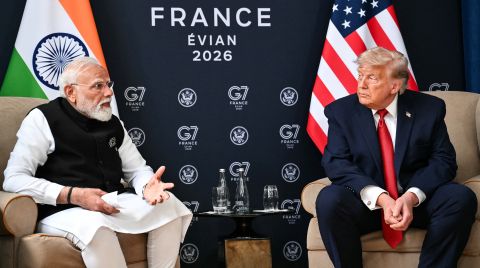
Speaking at the closing press conference on Tuesday, Macron described the summit as an exercise in managing disagreements while preserving international cooperation at a time of growing global instability.
The summit, held from June 15 to 17 in the French resort town of Évian-les-Bains, brought together leaders from the Group of Seven countries amid ongoing conflicts in Ukraine and the Middle East, renewed trade tensions, debates over artificial intelligence governance, and shifting transatlantic relations following the return of US President Donald Trump.
Macron said the discussions were often difficult and reflected genuine differences among participants on several major issues, including support for Ukraine, trade policy, relations with China, the regulation of emerging technologies, and approaches to regional conflicts.
Despite these divergences, he stressed that the summit succeeded in maintaining dialogue and producing practical coordination on several fronts. "We chose flexibility and honest exchanges over rigid declarations," Macron said, emphasizing that the objective was to preserve unity while acknowledging areas of disagreement.
French officials said the summit focused on addressing both immediate crises and long-term structural challenges. Macron highlighted efforts to coordinate policies on energy security, economic imbalances, sustainable growth, and responsible artificial intelligence development.
The French president also underscored the importance of broadening international partnerships beyond the G7. Leaders from several countries, including India, Brazil, Kenya, South Korea, Egypt, Qatar, and the United Arab Emirates, participated in outreach sessions dedicated to global economic development and regional security.
The summit unfolded against a complex geopolitical backdrop. The war in Ukraine remained a central topic, with differences emerging over peace negotiations and future military support for Kyiv. Discussions also addressed the recent US-brokered de-escalation involving Iran and the need to secure energy supplies and maritime trade routes.
Trade disputes were another source of friction, particularly over US tariff policies, industrial overcapacity concerns involving China, and competing visions for global economic governance.
Observers noted that Macron deliberately avoided pushing for a comprehensive final communiqué on all issues, opting instead for targeted statements and informal agreements to prevent negotiations from collapsing under competing national priorities.
The French president described this approach as a more realistic way to preserve cooperation in an increasingly fragmented international environment.
Throughout the summit, Macron repeatedly argued that multilateral institutions must adapt to a world where consensus is more difficult to achieve but remains essential for addressing shared challenges.
The 2026 G7 summit ultimately highlighted both the strengths and limitations of the forum. While it did not produce transformative agreements, it reaffirmed the G7's role as a platform for major democracies to coordinate responses to global crises, manage geopolitical tensions, and maintain dialogue despite significant disagreements.