

ALBAWABA- Iran’s Supreme Leader Ayatollah Mojtaba Khamenei formally appointed six senior military commanders, consolidating wartime leadership structures amid ongoing US-Iran tensions, stalled efforts to reopen the Strait of Hormuz, and a recent meeting between the Iranian president and the supreme leader.
The decrees replace or formalize roles left vacant or interim after the killings of several top officers in the US-Israeli strikes that began the conflict on 28 February 2026.
According to decrees published by the supreme leader’s office and reported by Iranian state media and international outlets, Major General Ali Abdollahi was appointed Chief of the General Staff of the Armed Forces, succeeding Lieutenant General Abdolrahim Mousavi, who was killed in the initial strikes. Abdollahi previously commanded the Khatam al-Anbiya Central Headquarters.
The decree directs him to enhance the capabilities and readiness of the Armed Forces and Basij, ensure effective responses to conventional, modern, cognitive and hybrid threats, and complete the integration of the General Staff with the Khatam al-Anbiya Headquarters. Brigadier General Kioumars Heydari was named his deputy.
Brigadier General Ahmad Vahidi was promoted to major general and appointed Commander-in-Chief of the Islamic Revolutionary Guard Corps, succeeding Lieutenant General Mohammad Pakpour, also killed early in the war. Vahidi, a longtime hardliner, previously headed the Quds Force, served as defence minister from 2009 to 2013 and interior minister from 2021 to 2024, and had held senior interim IRGC roles. He is under US sanctions and subject to an Interpol notice linked to the 1994 AMIA bombing in Argentina. Major General Mostafa Izadi was appointed deputy commander-in-chief of the IRGC.
Rear Admiral Ali Ozmaei was appointed commander of the IRGC Navy, succeeding Alireza Tangsiri, who was killed in an Israeli strike in March 2026. Ozmaei had long commanded the IRGC Navy’s Fifth Naval Region responsible for approaches to the Strait of Hormuz and had already been functioning in the top role; the decree formalizes the appointment. Hossein Taeb, former head of the IRGC Intelligence Organization, was named head of the Basij Organization, marking a notable return after earlier setbacks.
Khamenei’s decrees emphasize strengthening defence capabilities, revolutionary readiness, deterrence and responses to threats against the Islamic Republic. Some positions, notably those of Vahidi and Ozmaei, had already been filled on an interim basis; the formal decrees place the supreme leader’s clear authority on the structure.
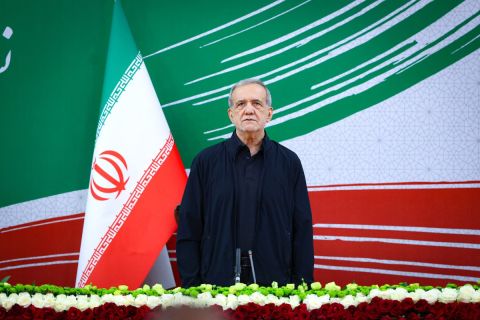
The appointments followed reports of a rare seven-hour meeting between President Masoud Pezeshkian and Supreme Leader Mojtaba Khamenei.
Pezeshkian said the discussion covered livelihoods, markets, employment, housing, the impact of sanctions, national resilience, unity, the repercussions of the war, military affairs, resource management, foreign exchange and energy issues, and economic ties with foreign partners.
According to the president, the supreme leader’s overriding message was the need to preserve internal unity amid external pressures. Mojtaba Khamenei has maintained a very low public profile since succeeding his father, who was killed in the 28 February strikes that also reportedly injured him. Communication with him has been described as difficult, and public footage has not yet been released, though officials have promised it.
The military reshuffle takes place against the backdrop of the prolonged conflict that began with US and Israeli strikes in late February 2026. Iran closed or heavily restricted the Strait of Hormuz in response. Limited traffic has been permitted under strict conditions, including permits from Iranian authorities and alternative routes due to mine risks, but normal commercial flow has not resumed. Iran and Oman have been negotiating new shipping lanes, with an agreement described as near final stages, yet Tehran has repeatedly insisted that full reopening depends on the United States meeting broader conditions.
Iranian officials have listed demands that include ending the US naval blockade of Iranian ports, lifting sanctions especially on oil, releasing frozen Iranian assets, paying compensation for war damage caused by US and Israeli attacks, and ending further military threats and aggression against Iran and its regional allies. Compensation and an end to sanctions and the blockade form the consistent core of these conditions. Iran has stressed that the strait will not return to its pre-war status and that management will involve coordination with Oman.
On the same day, US President Donald Trump responded on Truth Social to Iran’s compensation demands. He noted that Tehran was seeking reparations for damage from the five-month conflict, which he attributed to Iran’s nuclear ambitions, even though the issue had not featured in prior talks.
Calling the idea interesting, Trump announced that he was now demanding compensation from Iran for Americans killed or wounded by Iranian-linked roadside bombs and conflicts, including victims of the USS Cole bombing and thousands of others, as well as for the families of protesters Iran has killed over decades and in recent months.
He said he had instructed US negotiators to include the demand in all future talks. The reciprocal claim further complicates already strained indirect negotiations, currently limited to messages through intermediaries, over ending hostilities, sanctions, assets and access to the strategic waterway.